Ruggedized devices are hardware built to keep running through conditions that would kill ordinary electronics: extreme temperature, dust, water, vibration, and physical shock. They cover industrial tablets, hardened laptops, handheld scanners, panel PCs, and field sensors, and they are engineered and certified for durability rather than assembled from consumer-grade parts. On a factory floor, a pipeline, or a substation, they are the equipment that has to work every shift regardless of the environment.
What makes a device ruggedized?
Construction and certification. Reinforced casings, shock absorption, sealed ports, wide operating-temperature ranges, and gasketing against dust and water. The claims are backed by standards, not marketing: IP65 and IP67 ingress-protection ratings state how well a unit resists dust and water, and MIL-STD-810G covers military-grade tolerance for shock, vibration, humidity, and temperature. Those ratings are why a rugged tablet survives a drop onto a plant floor while a consumer one does not.
Where are ruggedized devices used?
In any setting where the environment is hard on equipment: manufacturing, oil and gas, utilities, transportation, warehousing, and field service. On the shop floor they run machine diagnostics, work instructions, and inventory tasks. In oil and gas, ruggedized sensors and controllers monitor processes in hazardous outdoor conditions. In logistics, hardened handhelds track goods through cold storage and loading docks.
Why do ruggedized devices matter for OT security?
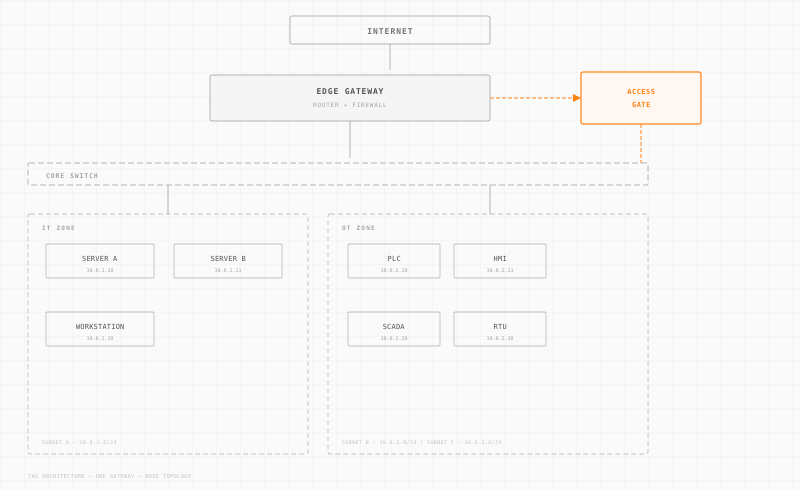
Because they are endpoints on the OT network, and durability is not security. A rugged HMI or handheld often has years of service life, runs older software, and rarely gets an agent or a patch on the same cadence as IT. It sits on the same operational technology network as the SCADA systems and PLCs it talks to, so if the network is flat, a compromised rugged device becomes a path to the control layer. The fix is not on the device: it is network segmentation and identity-bound access around it.
How does Access Gate fit?
Because Access Gate is agent-free, it secures ruggedized devices without installing anything on them or replacing them. It segments them from the rest of the network and enforces identity-bound access at the network layer, which suits hardware that is hard to patch and expensive to swap out. See Manufacturing Security.