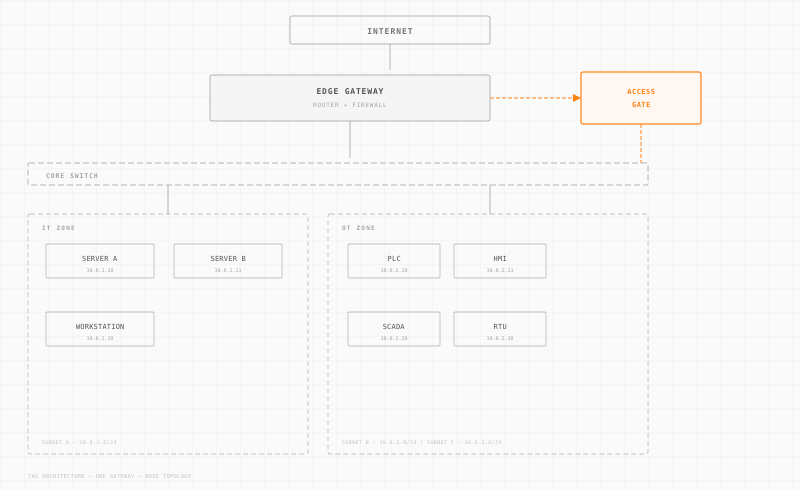
Secure communications refer to the protection of information exchanged between parties from unauthorized access and interception. This involves using encryption and other security measures to ensure that data transmitted over networks remains confidential and intact.
Understanding Secure Communications in OT/IT Cybersecurity
In the context of Operational Technology (OT) and Information Technology (IT) cybersecurity, secure communications are vital for protecting sensitive data that flows across networks, especially in industrial, manufacturing, and critical infrastructure environments. These environments often involve a mix of legacy systems and modern technologies, making the implementation of secure communications both challenging and necessary.
Communication security in these sectors typically encompasses a range of technologies and protocols designed to ensure the confidentiality, integrity, and authenticity of data. This includes the use of encryption protocols such as TLS (Transport Layer Security) and IPSec (Internet Protocol Security), which encrypt data to prevent eavesdropping and tampering during transmission.
Importance for Industrial, Manufacturing & Critical Environments
In industrial and critical infrastructure settings, secure communications are crucial due to the potential risks associated with data breaches. Unauthorized access to communication channels could lead to operational disruptions, safety hazards, and intellectual property theft. For instance, in a manufacturing plant, intercepted communications might allow a malicious actor to alter production processes or shut down critical systems.
The NIST SP 800-171 and CMMC frameworks emphasize the importance of securing communications to protect Controlled Unclassified Information (CUI) and ensure compliance with federal regulations.
Secure communications also play a significant role in adhering to the IEC 62443 standards, which provide a framework for ensuring the security of industrial automation and control systems. These standards dictate that communication pathways within control systems should be secured to protect the integrity and availability of the systems.
In Practice
Implementing secure communications in an OT/IT environment involves several practical steps:
- Encryption: Use strong encryption methods to protect data in transit. This can include implementing end-to-end encryption where feasible.
- Authentication: Ensure that only authorized users and devices can access the network and communicate over it. This may involve using digital certificates or multi-factor authentication.
- Network Segmentation: Separate network segments to limit the impact of a potential breach and control access to sensitive areas of the network.
- Monitoring and Logging: Continuously monitor communication channels for unusual activity and maintain logs for forensic analysis.
An example of secure communications in action could be a power grid operator using encrypted VPNs to secure remote access connections to critical systems, ensuring that any data exchanged is protected from interception and tampering.
Related Concepts
- Encryption: The process of converting information into a secure format that can only be read by someone with the appropriate decryption key.
- Network Segmentation: The practice of dividing a network into smaller segments to improve security and performance.
- Authentication: The process of verifying the identity of a user or device before granting access to a network or system.
- Transport Layer Security (TLS): A protocol that ensures privacy between communicating applications and their users on the Internet.
- IPSec (Internet Protocol Security): A suite of protocols designed to secure internet protocol communications by authenticating and encrypting each IP packet in a communication session.