Secure Sockets Layer (SSL) and Transport Layer Security (TLS) are cryptographic protocols designed to provide secure communication over a computer network. SSL is the predecessor of TLS, and while SSL is now considered obsolete, the term is often used interchangeably with TLS in practice.
Understanding SSL and TLS in OT/IT Cybersecurity
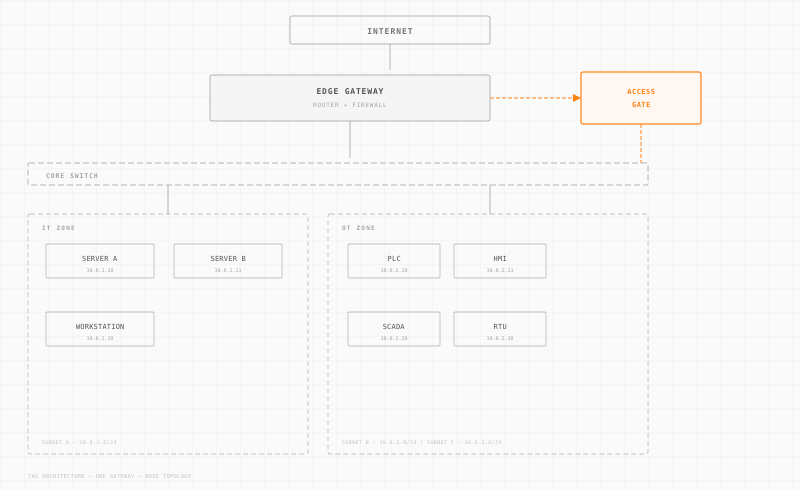
In the realm of OT/IT cybersecurity, SSL/TLS play a pivotal role in ensuring the confidentiality, integrity, and authenticity of data transmitted across networks. These protocols are essential for securing communications between various components in industrial environments, such as Human-Machine Interfaces (HMIs), Supervisory Control and Data Acquisition (SCADA) systems, and other critical infrastructure systems.
SSL/TLS achieve security by encrypting data that travels over the network, ensuring that sensitive information like passwords, commands, and operational data cannot be intercepted or tampered with by malicious actors. This is particularly crucial in environments where network breaches can lead to operational disruptions, safety hazards, or unauthorized access to critical systems.
Importance for Industrial, Manufacturing & Critical Environments
In industrial and manufacturing settings, where both Operational Technology (OT) and Information Technology (IT) systems coexist, maintaining secure communication channels is paramount. SSL/TLS protocols help protect data integrity and confidentiality, which are critical for preventing industrial espionage, sabotage, and cyberattacks that could lead to substantial financial and reputational damage.
Compliance and Standards
SSL/TLS are integral to achieving compliance with various cybersecurity standards such as:
- NIST 800-171: This standard requires the protection of Controlled Unclassified Information (CUI) in non-federal systems, emphasizing the need for encryption protocols like TLS for secure data transmission.
- CMMC (Cybersecurity Maturity Model Certification): TLS is often cited as a best practice for meeting the security requirements outlined in different CMMC levels, particularly for securing data in transit.
- IEC 62443: This series of standards for industrial automation and control systems highlights the importance of secure communication protocols to safeguard against cyber threats.
In Practice
Consider a manufacturing plant where multiple machines communicate with a central SCADA system. Implementing TLS ensures that the data exchanged between these machines and the SCADA system is encrypted, safeguarding against interception by unauthorized parties. Without TLS, sensitive operational data could be exposed to potential attackers, leading to unauthorized access or manipulation of critical systems.
SSL/TLS are also widely used in securing web-based applications and remote access solutions in industrial settings, allowing operators to securely access and manage systems from remote locations without compromising security.
Related Concepts
- Encryption: The process of encoding information to prevent unauthorized access.
- Public Key Infrastructure (PKI): A framework for managing public-key encryption and digital certificates.
- SCADA Security: Protecting SCADA systems from cyber threats.
- Network Segmentation: Dividing a network into smaller, isolated segments to improve security.
- Cybersecurity Standards: Guidelines and practices for protecting information systems and data.