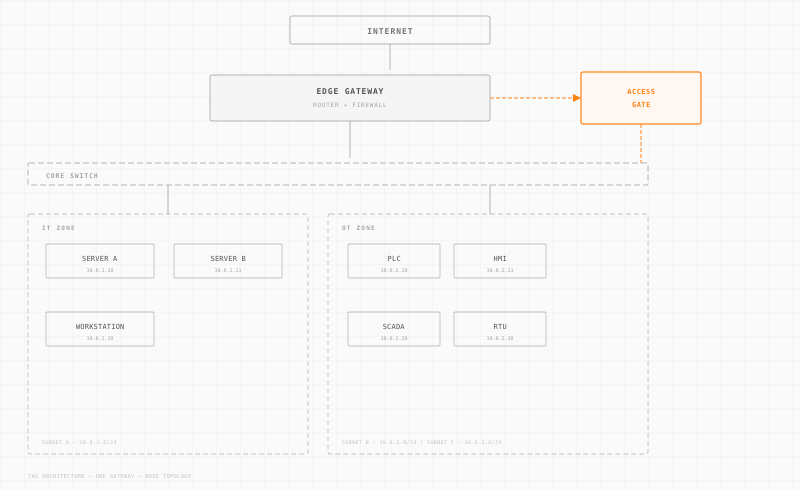
User Authentication is the process of verifying the identity of a user attempting to access a system. This is a critical component of cybersecurity, ensuring that only authorized individuals can access sensitive information and systems, particularly in environments where operational technology (OT) and information technology (IT) intersect.
Understanding User Authentication in OT/IT Cybersecurity
In the context of OT/IT cybersecurity, user authentication serves as the first line of defense against unauthorized access. Systems within industrial, manufacturing, and critical infrastructure environments often contain sensitive data and control mechanisms that must be protected against both internal threats and external attacks. User authentication mechanisms ensure that individuals accessing these systems are who they claim to be.
Authentication methods can vary widely, from simple password-based systems to more complex solutions involving multi-factor authentication (MFA). While password systems require something the user knows, such as a password, MFA combines multiple elements, such as something the user knows (password), something the user has (a security token), and something the user is (biometric verification).
Importance in Industrial, Manufacturing, and Critical Environments
For industrial and manufacturing sectors, as well as critical infrastructure, robust login authentication mechanisms are essential. These environments often rely on legacy systems that may not have been designed with modern security threats in mind. The introduction of sophisticated user authentication protocols helps protect against unauthorized access, which could lead to data breaches, operational disruptions, or even catastrophic physical consequences.
Applicable Standards and Regulations
Several standards and regulations emphasize the importance of strong user authentication protocols:
- NIST SP 800-171: This standard outlines requirements for protecting controlled unclassified information in non-federal systems, including the implementation of strong authentication mechanisms.
- CMMC (Cybersecurity Maturity Model Certification): Enforces stringent user authentication requirements for contractors working with the U.S. Department of Defense.
- IEC 62443: Focuses on security for industrial automation and control systems, emphasizing the need for secure access control, including user authentication.
In Practice
Consider a manufacturing plant where various teams need access to control systems for daily operations. Implementing a multi-layered identity verification process ensures that only authorized personnel can interact with critical systems. For instance, an operator might use a password and a fingerprint scan to log into a control panel. This dual-factor approach significantly reduces the risk of unauthorized access, protecting both the safety of the plant and the integrity of its operations.
Furthermore, regular audits and updates to authentication protocols are crucial in adapting to emerging threats. As cyber threats evolve, so too must the authentication measures, ensuring continuous protection of sensitive systems and data.
Related Concepts
- Multi-Factor Authentication (MFA)
- Identity and Access Management (IAM)
- Biometric Authentication
- Access Control
- Cybersecurity Protocols