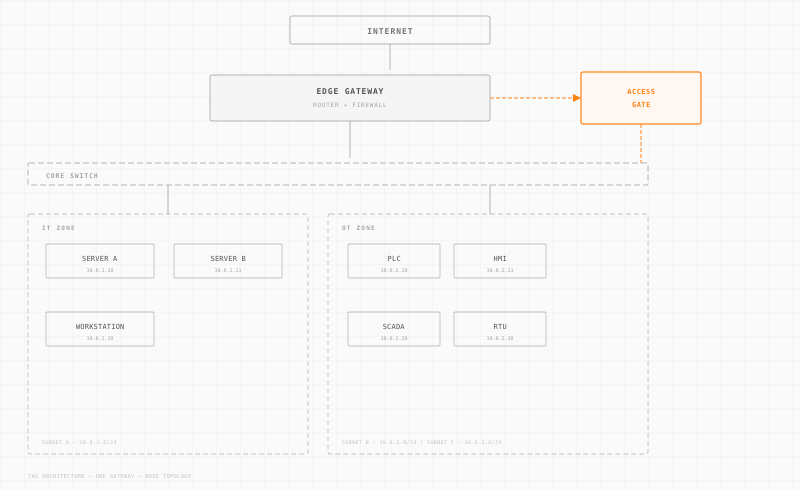
Firewall configuration refers to the process of setting up and managing the rules and policies that govern the flow of network traffic through a firewall. This involves specifying conditions under which network packets are allowed or denied access to the network, thereby protecting the system from unauthorized access and potential cyber threats.
Understanding Firewall Configuration in OT/IT Cybersecurity
In the context of Operational Technology (OT) and Information Technology (IT) cybersecurity, firewall configuration is crucial for creating a barrier that prevents malicious traffic from entering or exiting a network. Firewalls serve as a first line of defense in securing industrial, manufacturing, and critical infrastructure environments. Proper configuration ensures that only legitimate and necessary communications are permitted, while unauthorized access attempts are blocked.
Firewalls can be hardware-based, software-based, or a combination of both, and they operate on various network layers. The configuration process includes defining firewall rules that specify which types of traffic are permissible. These rules are based on several criteria such as IP addresses, protocols, ports, and application types.
Importance in Industrial Environments
In industrial and critical environments, such as manufacturing plants or power grids, the correct configuration of firewalls is vital to maintain system integrity and availability. These environments often include a mix of legacy and modern systems, which can be vulnerable to cyber threats if not properly secured.
IEC 62443, a series of standards on industrial communication networks, emphasizes the importance of implementing firewalls and configuring them correctly to protect critical infrastructure. Similarly, the NIST SP 800-171 guidelines provide a framework for protecting controlled unclassified information, highlighting the role of firewall configuration in safeguarding sensitive data.
Examples of Firewall Rules in Practice
-
Deny by Default: A common practice is to deny all network traffic by default, allowing only traffic that is explicitly permitted by rule. This minimizes potential entry points for attackers.
-
Segmentation: Firewalls can be configured to segment networks into smaller, isolated sections. This limits the spread of cyber threats and enhances control over data flow.
-
Application-Specific Rules: Allowing only specific applications to communicate over the network can prevent unauthorized applications from transmitting data, adhering to the principle of least privilege.
Why It Matters
The correct configuration of firewalls is critical for ensuring that OT/IT environments are secure against cyber threats. Firewalls that are misconfigured or left with default settings pose significant security risks, potentially leading to data breaches or operational disruptions. Given the increasing sophistication of cyber threats, maintaining an up-to-date and well-configured firewall is essential.
The Cybersecurity Maturity Model Certification (CMMC) also recognizes the importance of firewall configuration as part of a broader security posture for defense contractors.