
The short version.
On November 5, 2026, CISA, the FBI, HHS, USDA and DOT published a joint fact sheet: "US Government Partners Urge Hardening Industrial Refrigeration and Cold Chain Monitoring Systems." The agencies say they are aware of malicious cyber activity against these systems globally.
The attackers target electronic temperature controllers and commercial refrigeration controllers in retail grocery and cold storage. They use authentication bypass, arbitrary code injection or weak configurations on controllers that are unpatched or reachable from the internet. Then they force units into continuous heating and defrost. The fact sheet names no vendor, no CVE and no victim.
It lists eight mitigations. The two that matter most for a plant or warehouse engineer are taking controller panels off the internet and securing the remote access the refrigeration contractor uses. Below, each mitigation comes with what to do and how to check it.
What the fact sheet says.
The fact sheet is three pages, marked TLP:CLEAR. It names the sectors that rely on these systems: Healthcare and Public Health, Chemical, Food and Agriculture, and Transportation Systems, including refrigerated transport. They use them for remote temperature monitoring, continuous temperature logging, defrost cycle management and energy optimization.
The threat section is short. Attackers may exploit vulnerabilities or weaknesses in unpatched or internet-accessible controllers to remotely alter settings. The listed effects are:
- a change of temperature, which can shorten the system's service life, create a fire hazard, destroy inventory, or harm consumers who eat products stored unsafely
- loss of visibility into current temperatures, which the fact sheet calls a denial-of-view condition
The mitigations are mapped to the Cross-Sector Cybersecurity Performance Goals (CPGs) that CISA and NIST maintain. The agencies ask owners and operators to apply them immediately. In CISA's announcement, Chris Butera, CISA's Acting Executive Assistant Director for Cybersecurity, said: "Every organization that depends on refrigeration and monitoring systems should assume it could be a target."
What happened in Europe before the fact sheet.
The fact sheet does not cite specific incidents. Two European events came just before it, and they show what the attacks look like on real equipment.
French supermarkets, October 2026. On October 12, France's CERT-FR published alert CERTFR-2026-ALE-012 on attacks against remote controllers of refrigeration installations. It reports numerous compromises of Copeland xweb, Danfoss AK-SC series, Danfoss AK-SM series and Dixell xweb controllers, and it was updated on October 13 and 16. The alert names no CVE. Its main point is exposure: putting a management interface on the internet, it says, is contrary to good practice. Press reports put the number of affected stores in the hundreds. The French authorities have not publicly named the attackers.
The French Blood Establishment (EFS), November 2026. EFS said that on November 2, attackers raised the temperature and defrost thresholds of cold rooms at three of its sites. EFS was not attacked directly: its refrigeration equipment supplier was. EFS said its monitoring and alarm systems detected the change quickly, staff moved or secured the plasma, and no loss of blood products had been reported.
The EFS case is the one cold chain operators should study. The attackers reached the cold rooms through the supplier, which had remote access to the equipment.
How the attack works on a refrigeration system.
A typical site has a supervisor and many controllers. The supervisor is a small box or industrial PC with a web interface. It sets setpoints and defrost schedules, collects alarms and keeps the temperature log. Below it, case and cold room controllers often sit on a serial bus. In many sites the supervisor also sends alarms and data out to the contractor's monitoring service.
The contractor needs to reach the supervisor. The quick way to allow that is a port forward on the site's router, which puts the web interface on the internet. On a flat network, the same supervisor is also reachable from every office PC. Some contractors also install their own cellular router, which nobody on site manages.
From there the attack is a settings change. An attacker who logs in, or bypasses the login, changes setpoints and defrost parameters. There is no malware on the controller to find. The controller runs the new settings.
The table maps the fact sheet and the European reports to MITRE ATT&CK for ICS. Rows marked conditional describe a path the evidence makes likely, not one an agency has confirmed.
| Tactic | Technique (ID) | What happened here |
|---|---|---|
| Initial Access | Internet Accessible Device (T0883) | The fact sheet names internet-accessible controllers as targets. CERT-FR points to management interfaces exposed on the internet |
| Initial Access | Exploit Public-Facing Application (T0819) | The fact sheet lists authentication bypass and arbitrary code injection |
| Initial Access | External Remote Services (T0822) | Conditional: the supplier's remote access path, as in the EFS case |
| Lateral Movement | Default Credentials (T0812) | The fact sheet lists weak configurations and asks for default passwords to be changed |
| Impair Process Control | Modify Parameter (T0836) | Temperature setpoints and defrost thresholds changed |
| Impact | Manipulation of Control (T0831) | Units forced into continuous heating and defrost cycles |
| Impact | Denial of View (T0815) | Loss of visibility into current temperatures, named in the fact sheet |
| Impact | Damage to Property (T0879) | Shorter equipment service life and a fire hazard, named in the fact sheet |
| Impact | Loss of Productivity and Revenue (T0828) | Inventory loss in grocery and cold storage |
The eight mitigations as a checklist.
The first column is the fact sheet's mitigation and its CPG reference. The other two columns are our reading of how to apply and verify it on a refrigeration system.
| Mitigation (CPG) | What to do | How to check |
|---|---|---|
| Eliminate public internet exposure (3.S) | Remove port forwards and public IP addresses on supervisors and controller panels. If remote access must stay, put it behind a firewall or edge device on current firmware | Search your public IP ranges on Shodan or Censys for the supervisor's web interface. Read the NAT rules on each site router. Ask the contractor how they connect today |
| Isolate OT devices (3.I) | Put supervisors, controllers and gateways on a dedicated OT VLAN, separate from the business network | From an office PC, open the supervisor's web page. It should not load |
| Enforce credential security (3.A, 3.B, 3.F) | Change default passwords, set a strong password policy, and use phishing-resistant MFA where feasible | List every account on each supervisor. Try the factory account. Find out who knows the admin password, contractor included |
| Apply patches (2.A, 2.B) | Keep firmware current. Run a lifecycle process that finds, retires and replaces end-of-life devices | Compare each unit's firmware with the vendor's current release. List units the vendor no longer supports |
| Restrict access (3.H) | Allow only the devices and IP addresses authorized to make changes | Firewall rules to the supervisor name specific sources. None says "any" |
| Have reliable backups (3.O) | Keep current backups offsite and offline, and test them | Restore a supervisor configuration, setpoints and defrost schedules included, to a test unit |
| Monitor and report (3.Q) | Enable logging and review it. Where logs are missing, collect network traffic between assets | Know where the supervisor's logs go and who reads them. A login from a new source should raise an alert |
| Review setpoint ranges | Set safe setpoint limits on the devices below the controllers, and alert on deviations | Check the limits on each case controller. Trigger a test alarm out of hours and time how long it takes to reach a person |
Two additions from the European cases. CERT-FR asks for a full configuration review, defrost schedules in particular, because defrost settings are what the attackers changed. And EFS caught the attack because its temperature alarms reached people fast. An alarm path that does not depend on the supervisor itself, such as an independent temperature logger, keeps working if the supervisor is the thing that was changed.
How Access Gate helps, and where it stops.
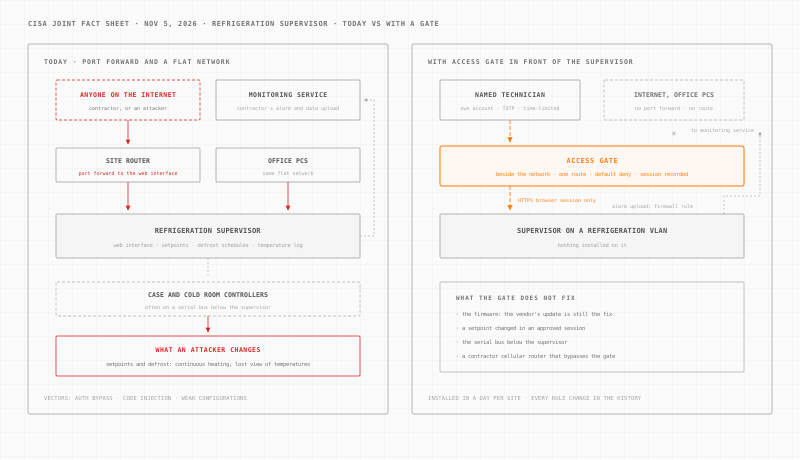
The fact sheet asks for two things the controller cannot do for itself: separate it from everything else and make remote access safe. Access Gate handles both in front of the supervisor.
It plugs into the site's existing network, beside it. You then add one route on the existing router so traffic to the refrigeration VLAN goes through Access Gate. Nothing is installed on the supervisor or the controllers. It installs in a day per site. Once that route is in place, the port forward on the router can be removed.
The contractor connects to one machine, as a named person. With privileged access management, the technician opens the supervisor's web interface in a browser session through the gate. They sign in with their own account and a TOTP code. TOTP is not phishing-resistant, so where your identity provider enforces a phishing-resistant factor, the sign-in can go through it over OIDC or SAML. Access lasts for the intervention window and then revokes itself. The session is recorded. This replaces the contractor IP filtering that CERT-FR accepts only as an emergency measure.
Everyone else has no route. Access control lists deny by default. One rule lets the refrigeration group reach the supervisor over HTTPS. Office PCs get no route to the supervisor. That enforces the separation the fact sheet asks for at a single point. Where controllers speak Modbus TCP on the IP network, the gate filters command by command, so a monitoring client can read temperatures without being able to write setpoints.
Every change leaves a record. The enclave change history keeps who opened which rule and when. With the session recordings, this covers the fact sheet's logging item for the remote access path. It also gives a food or pharma quality team evidence of who touched a cold room's settings.
The limits are real. Access Gate does not patch the controller or fix an authentication bypass in its firmware: the vendor's update is still the fix. A contractor with an approved session can still change a setpoint, which is why setpoint limits and alarms stay on the list. The gate does not see the serial bus between the supervisor and the case controllers. A device on the refrigeration VLAN itself is beyond its control. A cellular router the contractor installed bypasses the gate completely, so find those first. And the supervisor's outbound alarm upload to the contractor's monitoring service is a separate flow: allow it on your firewall to that service's address only.
For the wider design, see secure remote access, OT network security, OT identity and our page on manufacturing cybersecurity. Our post on vendor access risks in OT covers the contractor problem in more depth.
What to do this week.
- List every refrigeration supervisor and controller with its site, model, firmware version and the contractor who maintains it.
- Search your public IP ranges for refrigeration web interfaces and remove every port forward you find.
- Ask each contractor in writing how they connect, from where, and with which account.
- Walk the plant rooms and look for cellular routers that nobody on your team manages.
- Change every default and shared password on the supervisors and controllers.
- Review setpoints, setpoint limits and defrost schedules against your documented values.
- Trigger a test temperature alarm out of hours and confirm it reaches a person.
For every CISA advisory we have covered, see the ICS security advisories archive.
Sources: CISA, FBI, HHS, USDA and DOT joint fact sheet "US Government Partners Urge Hardening Industrial Refrigeration and Cold Chain Monitoring Systems" (November 5, 2026), also published by the FBI on IC3; CERT-FR alert CERTFR-2026-ALE-012 (October 12, 2026, updated October 16); EFS's November 3 statement as reported by BleepingComputer; and MITRE ATT&CK for ICS. The CISA quote is from the agency's announcement as carried by BleepingComputer. The fact sheet names no vendor; the products listed above are from CERT-FR.