
The short version
On October 29, 2026, CISA republished Hitachi Energy PSIRT 8DBD000224 as ICSA-26-302-02. It covers the TRO600 series, the industrial cellular routers that connect substations and distribution automation sites to a utility's network.
The serious one is CVE-2026-106087: anyone who reaches the router can read or download arbitrary files without logging in, including configuration files and password data. CVSS v3.1 7.5, v4 8.7. The second, CVE-2026-10756, lets a logged-in user use port forwarding to reach services meant for localhost only. CVSS v3.1 7.5, v4 7.7. Version 9.2.2.1 fixes both. No exploitation is reported.
The two flaws chain. The file read hands over the passwords, and the passwords are the login the second flaw needs. A router's credentials also tend to open whatever the router talks to. So until 9.2.2.1 is installed, the control that matters is who can reach the TRO600 management interface at all.
What the advisory says
- Vendor advisory: Hitachi Energy PSIRT 8DBD000224, first released October 27, 2026. CISA republished it on October 29.
- Product: TRO600 series. Affected: 9.2.1.6 and prior, and 9.1.1.0 and prior.
- Reported by: Hitachi Energy's internal team.
- Scope: Energy sector, deployed worldwide, vendor headquartered in Switzerland.
- Exploitation: SSVC marks it as none. Neither CVE is in the KEV catalog (version 2026.11.18, checked November 19, 2026).
| CVE | CWE | CVSS v3.1 | CVSS v4 | What it allows, per the advisory |
|---|---|---|---|---|
| CVE-2026-106087 | CWE-306, Missing Authentication for Critical Function | 7.5 | 8.7 | An unauthenticated attacker reads or downloads arbitrary files, including sensitive configuration files and password data |
| CVE-2026-10756 | CWE-923, Improper Restriction of Communication Channel to Intended Endpoints | 7.5 | 7.7 | An authenticated attacker uses port forwarding to reach services bound to localhost, with access to sensitive functions and information and an availability impact |
| Flaw | Affected, per the advisory | Fixed in |
|---|---|---|
| CVE-2026-10756 | 9.2.1.6 and prior | 9.2.2.1 |
| CVE-2026-106087 | 9.1.1.0 and prior (CISA's page also lists 9.2.1.6 and prior) | 9.1.2.0 on the 9.1 line, and 9.2.2.1 |
Two details to read carefully. CISA's web page lists both version lines under the file read, while the machine-readable CSAF file maps it to 9.1.1.0 and prior only. Either way, 9.2.2.1 is listed as fixed for both CVEs, so it is the target. Hitachi Energy's summary also says the flaws "can be exploited for remote code execution". Neither CVE description describes code execution, so we treat the confirmed impact as file disclosure and access to localhost services. Ask Hitachi Energy PSIRT if the difference matters for your risk assessment.
No product-specific workaround is listed. The advisory gives Hitachi Energy's general mitigation factors and CISA's standard practices: no direct internet connection, firewalls with a minimal number of ports open, and isolation from business networks.
What a TRO600 is, and where it sits
Hitachi Energy introduced the 4G TRO600 portfolio in 2021 and added NB-IoT and Cat-M options in 2023. The TRO610 is described as a compact, DIN-rail cellular router for industrial IoT, typically installed in a cabinet at a substation or remote site. It has up to two Gigabit Ethernet ports, serial interfaces for legacy field devices, optional Bluetooth for local sensors, and 2G to 4G and private LTE radios. Hitachi Energy positions it for field area networks and distribution automation, and manages the fleet through its SuprOS network management system, which also manages RTU500 controllers.
So the TRO600 is the link between a field site and the control center. On one side are the devices it serves: RTUs, distribution automation controllers, sensors. On the other is the utility WAN, over a carrier or private LTE network. Every device at the site sends its traffic to the control center through it.
How the flaws chain
Step one needs no login. CVE-2026-106087 lets any host that reaches the router read files from it. The advisory names configuration files and password data. It does not say whether the passwords are stored in cleartext or as hashes, or which service exposes the read.
Step two turns the files into access. A router's configuration usually holds what it needs to join the utility network: management accounts, VPN keys or pre-shared keys, and the addresses of the devices behind it. The advisory does not list what the TRO600 stores, so check your own configuration for each of these. Any credential reused on other routers, on SuprOS or on the RTUs behind the router widens the reach.
Step three uses the login. With a valid account, CVE-2026-10756 lets the attacker forward ports to services bound to localhost on the router. Those services were meant to be unreachable from the network. The advisory says the result is access to sensitive functions and information, plus an availability impact. On 9.1.1.0 and earlier, both flaws are listed, so the whole chain runs on one device.
The table maps the flaws to MITRE ATT&CK for ICS. It describes what the flaws allow, not an observed attack.
| Tactic | Technique (ID) | How it applies here |
|---|---|---|
| Initial Access | Internet Accessible Device (T0883) | Conditional: a TRO600 management interface reachable from the internet or a carrier network with public addressing |
| Initial Access | Exploit Public-Facing Application (T0819) | The unauthenticated file read, CVE-2026-106087, against a reachable management service |
| Collection | Data from Local System (T0893) | Reading configuration files and password data from the router |
| Persistence, Lateral Movement | Valid Accounts (T0859) | Using recovered password data to log in to the router, or to other devices that share the credential |
| Command and Control | Connection Proxy (T0884) | Port forwarding through the router to services bound to localhost, CVE-2026-10756 |
| Lateral Movement | Remote Services (T0886) | Possible consequence: recovered credentials used against RTUs, SuprOS or other routers |
| Inhibit Response Function | Denial of Service (T0814) | The availability impact the advisory lists for CVE-2026-10756 |
What to do, whatever you run
Inventory first. List every TRO600 with its firmware version and its site. A fleet of field routers drifts, so check the devices, not the purchase records.
Plan 9.2.2.1. It is the one release listed as fixing both CVEs. On the 9.1 line, 9.1.2.0 closes the file read only. Roll out through SuprOS or your usual process, starting with the routers whose management interface is reachable from the widest network.
Treat the passwords as exposed. If a router on an affected version has had its management interface reachable from anywhere you do not control, assume its configuration has been read. Rotate the router's accounts and any VPN or pre-shared keys it holds, and stop reusing one password across the fleet.
Shrink who reaches the management interface. Only SuprOS and named engineers need it. Make sure no TRO600 answers management traffic from the internet or the open carrier network, which usually means a private APN and no public IP on the management side. Ask your carrier and Hitachi Energy which services you can turn off.
Keep the devices behind the router separate from the router. A stolen router credential should not open the RTU behind it. Give the RTUs their own accounts, and allow only the SCADA front end to reach their protocol ports.
How Access Gate helps, and its limits
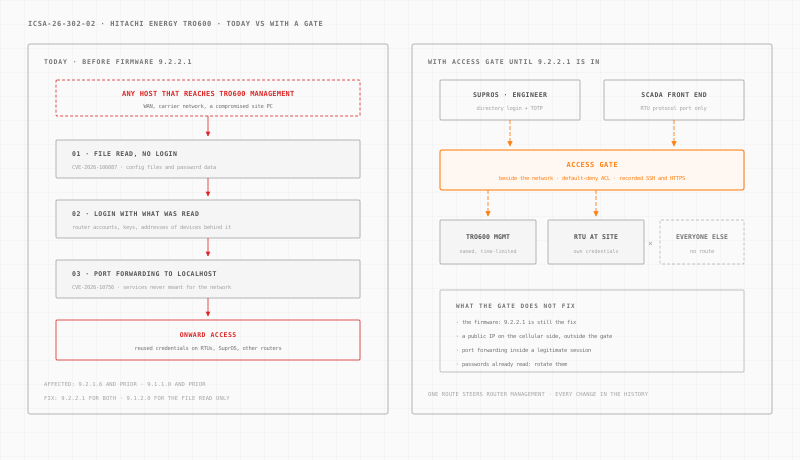
Access Gate is an appliance that connects beside your existing network. For a TRO600 fleet, it goes where management traffic to the routers converges, usually the control center or the head end of the private LTE or VPN network. One route on the existing router then steers management traffic to the TRO600 subnets through it. Nothing is installed on the routers. For many field sites on one console, see Access Gate Fleet.
A per-asset rule decides who reaches each router. Access control lists are default deny. One rule lets SuprOS reach the TRO600 management services. Another lets named engineers reach them after signing in. Every other host gets no route, which keeps the unauthenticated file read out of reach of anything on the WAN that is not on the list.
A named engineer signs in first, with MFA. An access screen asks for a directory login and a TOTP code before a workstation reaches a router. Access expires after 15 minutes, 1 hour or 8 hours. A password lifted from a router configuration does not get anyone past the gate without the second factor.
Router sessions are recorded. With privileged access management, SSH and the HTTPS admin interface open in a browser session tied to a name, time-limited and recorded. If someone tries port forwarding inside a session, there is a record of who did it and when. Every rule change lands in the enclave change history.
The same rules protect what sits behind the router. Protocol-aware rules at a site can let the SCADA front end alone reach an RTU's protocol port, so a stolen router credential does not open the RTU. See OT network segmentation.
The limits are real. Access Gate does not patch the TRO600, and it does not detect these CVEs. It cannot filter traffic that reaches the router's cellular interface without passing through the gate: if a TRO600 has a public IP on the carrier side, the fix is at the carrier and in the router's own configuration. A user with a legitimate session can still exploit CVE-2026-10756. Version 9.2.2.1 is still the fix.
For NERC CIP, start with scope. Distribution automation is often outside the Bulk Electric System. A TRO600 that carries routable traffic for a BES Cyber System, for example at a transmission substation, can be in scope, possibly as an EACMS if it controls access to the Electronic Security Perimeter. Where it is in scope:
- CIP-007 R2 asks you to evaluate the patch within 35 calendar days, then apply it or keep a dated mitigation plan. While a router waits for 9.2.2.1, the access rules and session records are that plan's proof.
- CIP-007 R1 asks you to enable only the logical network accessible ports you need. CVE-2026-10756 makes services bound to localhost reachable from the network, so note it in that review.
- CIP-007 R5 governs the passwords the file read exposes. If a configuration may have been read, change them now rather than waiting for the periodic change.
- CIP-005 R2 asks for interactive remote access through an Intermediate System with encryption and multi-factor authentication.
We covered the same vendor's substation stack in the RTU500 and MicroSCADA X SYS600 advisories, and SuprOS manages both RTU500s and TRO600s. See also power grid, secure remote access and OT identity.
What to do this week
- List every TRO600 with its firmware version and site.
- Get 8DBD000224 from Hitachi Energy PSIRT and schedule 9.2.2.1.
- Test who reaches TRO600 management from the internet, the carrier network and the corporate network.
- Rotate router passwords and keys on any affected router that was reachable, and end password reuse across the fleet.
- Check that RTU credentials differ from the router credentials at each site.
- Log the CIP-007 evaluation with today's date for in-scope routers, and pick update or mitigation plan per asset.
- Route router management through one named, recorded entry point.
Every other advisory we have covered is in the ICS security advisories archive.
Sources: CISA ICS Advisory ICSA-26-302-02 (October 29, 2026) and its CSAF file, a republication of Hitachi Energy PSIRT 8DBD000224 (October 27, 2026); Hitachi Energy's TRO610 product page and its 2023 blog on wireless communication for distribution grids; the CISA Known Exploited Vulnerabilities catalog, version 2026.11.18, checked November 19, 2026; NERC Reliability Standards CIP-005-7 and CIP-007-6; and MITRE ATT&CK for ICS. Confirm affected versions and update steps with Hitachi Energy before changing a production router.