
The short version
On November 3, 2026, CISA published ICSA-26-307-01 for Subnet Solutions PowerSYSTEM Center (PSC). PSC is the server many electric utilities use to manage relays, RTUs and gateways across their substations. It keeps the device inventory, the settings history, the firmware records and the vaulted passwords for those devices.
The advisory covers two CVEs, both CVSS v3.1 9.0. With CVE-2026-63017, a low-privileged user can reach resources limited to administrators. With CVE-2026-63774, a user can run SQL commands through the report designer. Both need a valid PSC account and an adjacent network. CISA says they are not exploitable remotely and reports no exploitation.
The advisory does not call for an emergency patch. Plan the update now, because of what the server holds. The fix is 2026 Update 1.1, or 2020 Update 30 on the 2020 line. Until it is installed, who holds a PSC account, and from where they reach the server, is what you control.
What the advisory says
- Vendor and product: Subnet Solutions Inc., headquartered in Canada. PowerSYSTEM Center, deployed worldwide.
- Sectors: Energy and Critical Manufacturing.
- Reported by: Chinmay Patel of Digital Boundary Group, and Subnet Solutions.
- Exploitation: none known. SSVC: exploitation none, not automatable, technical impact total. Not in the KEV catalog on November 19, 2026.
| CVE | Weakness | CVSS v3.1 / v4 | What it allows, per the advisory | Product lines |
|---|---|---|---|---|
| CVE-2026-63017 | Incorrect authorization (CWE-863) | 9.0 / 9.4 | A low-privileged, authenticated user accesses resources normally limited to administrators | 2020, 2024, 2026 |
| CVE-2026-63774 | SQL injection (CWE-89) | 9.0 / 9.4 | Insufficient input validation in the report designer lets an authenticated user run unauthorized SQL commands | 2024, 2026 |
Both vectors read adjacent network, low complexity, low privileges, no user interaction, scope changed, with high impact on confidentiality, integrity and availability.
| Product line | Affected versions | Fix |
|---|---|---|
| PowerSYSTEM Center 2026 | 7.0.x to 7.1.x | 2026 Update 1.1 |
| PowerSYSTEM Center 2024 | 6.0.x to 6.2.x | Upgrade to 2026 Update 1.1. The 2024 line gets no update of its own |
| PowerSYSTEM Center 2020 | 5.29.x and earlier | 2020 Update 30, for CVE-2026-63017. The 2020 line is not listed for CVE-2026-63774 |
The 2024 row is the one that costs time. Moving from 6.x to the 2026 line is a version upgrade, so test it before it reaches production. Subnet Solutions' System Integration team and customer support handle upgrades at support@subnet.com or (403) 270-8885.
This is not the first CISA advisory for the product. ICSA-25-100-08, in April 2025, covered an out-of-bounds read and a deserialization flaw in PSC 2020.
Why a device management server is a high-value target
PSC sits between the corporate network and the substations. Subnet describes it as a multi-vendor system of record for protection and control devices, with password rotation and vaulting, settings harvest and compare, firmware campaigns and brokered remote access. Engineers sign in with their directory account, and PSC retrieves the device credential from its vault. Vendor tools run on PSC's Client Access Server, so laptops do not connect directly to device networks.
That design is good practice, but it puts the trust in one place. The server knows every relay password and can push settings to every device it manages. A flaw that lets a low-privileged user act as an administrator lands on the one machine that can reach the whole fleet.
The advisory does not say which administrator resources CVE-2026-63017 exposes. It does not say the vault is readable, and we do not claim it is. The SQL injection gives a user a path to the PSC database. What that database holds in your configuration is the question to put to Subnet Solutions.
The vendor's workaround points to the browser client. Subnet asks operators to disable the F12 Developer Tools for Client Access Server users. Our reading is that the authorization flaw can be triggered from a normal user session in the browser. The advisory does not describe the mechanism.
The table maps the flaws to MITRE ATT&CK for ICS. It describes what the flaws allow, not an observed attack.
| Tactic | Technique (ID) | How it applies here |
|---|---|---|
| Initial Access, Lateral Movement | Remote Services (T0886) | A user session to PSC or its Client Access Server, the starting point for both CVEs |
| Persistence, Lateral Movement | Valid Accounts (T0859) | Both CVEs need a low-privileged PSC account. Shared or contractor logins widen who holds one |
| Privilege Escalation | Exploitation for Privilege Escalation (T0890) | CVE-2026-63017: a low-privileged user reaches administrator resources |
| Collection | Data from Information Repositories (T0811) | CVE-2026-63774: SQL commands against the PSC database through the report designer |
| Impair Process Control | Modify Parameter (T0836) | Possible consequence: device settings changed through a server that pushes them to the fleet |
| Inhibit Response Function | Loss of Protection (T0837) | Possible consequence, if protection relay settings are altered |
How the advisory maps to NERC CIP
Utilities buy PSC to meet NERC CIP requirements. That is why a flaw in it touches compliance as well as security. How you classify the server decides which requirements apply. Many registered entities treat it as an EACMS (Electronic Access Control or Monitoring System), some as part of a BES Cyber System. Confirm scope with your compliance team.
| Requirement | What it asks | How ICSA-26-307-01 applies |
|---|---|---|
| CIP-007 R2, patch management | Evaluate released security patches at least every 35 calendar days, then apply them or create a dated mitigation plan within 35 days | 2026 Update 1.1 and 2020 Update 30 enter your evaluation cycle. If you cannot apply them, the mitigation plan needs specific controls |
| CIP-007 R5, system access control | Authenticate interactive access, change default passwords, enforce password parameters, change passwords at least every 15 months | PSC often produces this evidence for relays. CVE-2026-63017 weakens the role separation behind it |
| CIP-005-7 R2, interactive remote access | Remote access through an Intermediate System with encryption and multi-factor authentication. R2.4 and R2.5: see and disable active vendor sessions | When PSC brokers remote sessions, its user accounts are on that path. Who holds them matters |
| CIP-010-4 R1, configuration change management | Keep a baseline that includes installed security patches, and update it within 30 days of a change | The update changes the server's baseline. PSC also holds the device baselines that CIP-010 evidence relies on |
| CIP-007 R4, security event monitoring | Log security events. For high impact systems, review a summary at least every 15 calendar days | The vendor workaround asks you to monitor PSC user activity records. Feed them into this review |
What to do first
Find every PSC installation. That includes the central server, each PowerSYSTEM Center For Stations instance and every Client Access Server. Write down the product line and version of each one, because the line decides the fix.
Plan the update. The 2026 line takes Update 1.1. The 2020 line takes Update 30. On the 2024 line, budget a version upgrade, since the fix is only in the 2026 line.
Apply the workarounds now on every server you cannot update this cycle. Disable the report designer for users who do not need it. Disable the F12 Developer Tools for Client Access Server users through your browser policy. Review user activity records against your acceptable use policy.
Reduce who holds an account. Both CVEs start with a valid login. Remove dormant accounts, end shared logins, and review contractor and vendor accounts. Until the update, treat every low-privileged account as a possible administrator.
Reduce who reaches the server. CISA's standard guidance applies: keep the server off the internet, behind a firewall, away from the business network, and treat a VPN as only as secure as the devices connected to it.
How Access Gate helps, and its limits
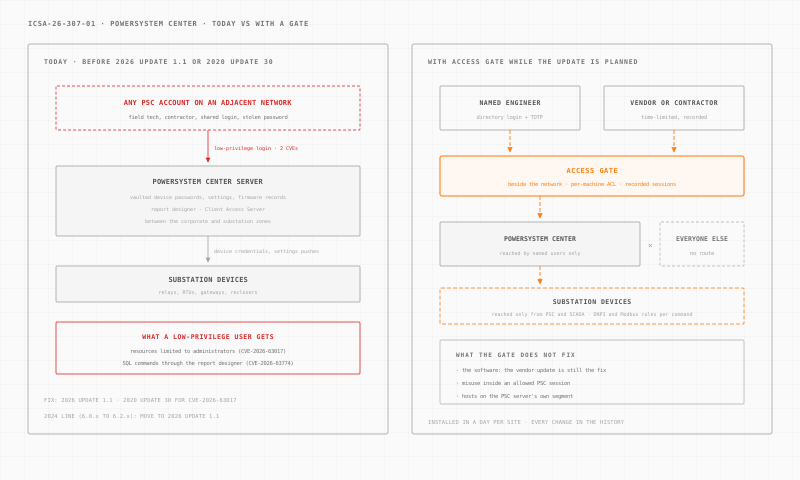
Access Gate is an appliance installed at each site. It connects beside your existing network. One route on the current router then steers traffic to the PSC server through it. Nothing is installed on PSC or on the substation devices. It is installed in a day per site.
A per-machine rule decides who reaches PSC. Access control lists are default deny. One rule lets the engineering subnet reach the PSC web client. Every other host on the corporate or substation network gets no route, which narrows the adjacent network both CVEs need.
A named person signs in before reaching the server. An access screen asks for a directory login with a TOTP code. Access expires after 15 minutes, 1 hour or 8 hours. A shared PSC login is then tied to the person who used it.
Vendor sessions are recorded. With privileged access management, a contractor opens a time-limited, browser-based session to the Client Access Server. The session is recorded and tied to a name, which helps show the active vendor sessions CIP-005 R2.4 asks you to determine. Every rule change lands in the enclave change history.
The substation side gets the same treatment. Relays and RTUs can be placed behind the gate so that only PSC and the SCADA front end reach them. Access Gate filters DNP3 and Modbus per command, so a host that should only read values cannot write settings.
The limits are real. Access Gate does not patch PSC and does not detect these CVEs. A user with an allowed session can still exploit CVE-2026-63017 or CVE-2026-63774, and PSC itself is allowed to reach the devices it manages. A host on the PSC server's own segment, outside the gate, is beyond its control. The vendor update is the fix. The gate narrows who can try before it is installed and records what they did.
For CIP-007 R2, the gate supports the mitigation plan. While PSC waits for its upgrade, the access rules, sign-in logs and session recordings document the controls you put in place. We covered the same substation pattern for Hitachi Energy RTU500 and SYS600. See also power grid, secure remote access, OT identity and our guide to secure OT remote access.
What to do this week
- List every PSC server, For Stations instance and Client Access Server, with product line and version.
- Log the CIP-007 R2 evaluation with today's date, and choose update or mitigation plan for each server.
- Disable the report designer for every user who does not need it.
- Disable F12 Developer Tools for Client Access Server users through browser policy.
- Remove dormant, shared and expired contractor accounts in PSC.
- Test which hosts reach the PSC server from the business network, the vendor VPN and the substations.
- Book the 2024-to-2026 upgrade with Subnet Solutions if you run the 2024 line.
Every other advisory we have covered is in the ICS security advisories archive.
Sources: CISA ICS Advisory ICSA-26-307-01 (November 3, 2026) and its CSAF file; CISA ICS Advisory ICSA-25-100-08; the Subnet Solutions PowerSYSTEM Center product page; the CISA Known Exploited Vulnerabilities catalog, version 2026.11.18, checked November 19, 2026; NERC Reliability Standards CIP-005-7, CIP-007 and CIP-010-4; and MITRE ATT&CK for ICS. Confirm affected versions and the upgrade procedure with Subnet Solutions before changing a production server.