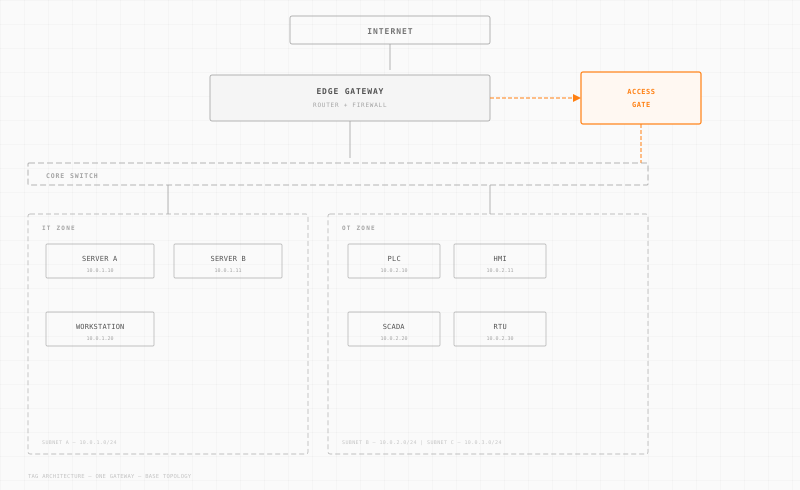
Un Programmable Logic Controller (PLC) est un ordinateur industriel durci qui lit des entrées provenant de capteurs et d'interrupteurs, exécute un programme de commande et pilote des sorties vers des moteurs, des vannes et des actionneurs. Il a été conçu pour remplacer des bancs de relais câblés en dur, et il fait aujourd'hui tourner les procédés physiques dans presque toutes les usines, centrales et infrastructures de service. Quand un PLC s'arrête ou se dérègle, le procédé qu'il commande s'arrête ou se dérègle avec lui.
Qu'est-ce qu'un automate programmable ?
Un PLC est un ordinateur dédié doté d'un microprocesseur, d'un ensemble d'E/S numériques et analogiques, et d'une ou plusieurs interfaces de communication. Il se trouve sur l'atelier, prend des mesures auprès des appareils de terrain, évalue un programme de commande selon un cycle de scrutation fixe et positionne ses sorties en conséquence, des milliers de fois par seconde. Des fabricants comme Siemens (S7), Rockwell Automation (Allen-Bradley), Schneider Electric (Modicon) et Mitsubishi dominent le parc installé, et beaucoup de ces unités fonctionnent depuis une décennie ou plus.
Comment fonctionne un PLC ?
Chaque cycle de scrutation fait les trois mêmes choses : lire toutes les entrées, exécuter la logique de commande, puis écrire toutes les sorties. La logique est généralement écrite dans les langages de la norme IEC 61131-3, le plus souvent en ladder logic, conçu pour ressembler à ce qui est familier aux ingénieurs formés aux schémas à relais. Les PLC communiquent entre eux et avec les systèmes de supervision via des protocoles industriels comme Modbus, EtherNet/IP et PROFINET, ce qui les place au cœur de l'architecture SCADA et système de contrôle industriel qui fait fonctionner un site.
Pourquoi les PLC constituent-ils un risque de cybersécurité en OT ?
La plupart des PLC ont été conçus pour la fiabilité, pas pour un réseau hostile. Ils sont fréquemment livrés sans authentification, avec des protocoles non chiffrés et un firmware pénible à corriger pendant une campagne de production. Quiconque peut atteindre un PLC sur le réseau peut souvent lire ou réécrire sa logique directement. Stuxnet a montré ce que cela signifie en pratique : il a reprogrammé des PLC Siemens pour détruire des centrifugeuses tout en remontant des mesures normales. Parce qu'un PLC est la couture entre le réseau et un procédé physique, un PLC compromis n'est pas qu'un problème de données, il peut faire bouger des machines.
Quelles normes régissent la sécurité des PLC ?
Aucune norme unique n'est propre aux PLC, mais plusieurs fixent les attentes. IEC 62443 est le cadre de référence pour sécuriser les systèmes d'automatisation et de contrôle industriels, couvrant les zones, les conduits et le durcissement au niveau des appareils. NIST SP 800-171 et le CMMC s'appliquent lorsque l'usine traite des informations de contrats de défense, et la directive NIS2 de l'UE fait entrer de nombreux opérateurs industriels dans le périmètre. Le fil conducteur de tous ces cadres est le contrôle d'accès et la segmentation réseau, car on a rarement la possibilité de corriger le contrôleur lui-même.
En quoi un PLC diffère-t-il d'un système SCADA ou d'un DCS ?
Un PLC commande une machine ou une cellule de procédé. Le SCADA est la couche de supervision qui surveille et coordonne de nombreux contrôleurs sur un site ou une région, généralement au travers d'un HMI. Un Distributed Control System (DCS) mêle les deux pour les grands procédés continus comme le raffinage ou la chimie, avec une logique de commande répartie dans l'usine. En bref : le PLC commande, le SCADA surveille, et un DCS fait les deux à l'échelle de l'usine.
Comment l'Access Gate aide
Vous ne pouvez généralement pas ajouter d'authentification ni corriger un PLC en fonctionnement, aussi le geste pratique consiste à contrôler ce qui peut l'atteindre. L'Access Gate enveloppe les contrôleurs dans un overlay sans agent, fondé sur l'identité : les sessions d'ingénierie et de vendeur vers un PLC sont relayées et journalisées, le trafic est-ouest entre cellules est microsegmenté pour qu'un point d'appui sur une ligne ne puisse pas pivoter vers la suivante, et la découverte d'actifs inventorie les contrôleurs dont vous ignoriez l'exposition. La supervision consciente du protocole observe le trafic Modbus et EtherNet/IP et le transmet à votre SIEM, le tout sans toucher au contrôleur.