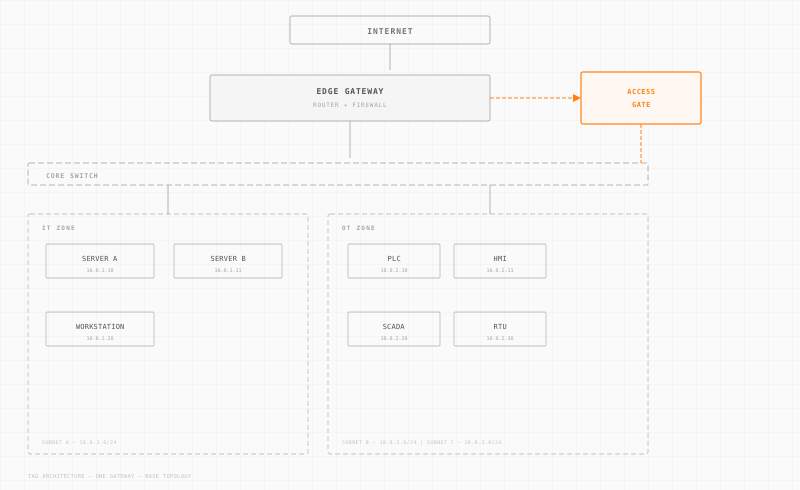
Third-party remote access is the access an organization grants to outside parties, such as equipment vendors, system integrators, OEMs, and maintenance contractors, so they can connect from off site to service or support internal systems. It is necessary work, because the people who know a machine best often do not sit inside your building. It is also one of the most frequently exploited access paths, because that outside connection is hard to see, hard to control, and often over-privileged.
What is third-party remote access?
It is the specific case of remote access where the person connecting does not work for you. A drive manufacturer dials in to tune a motor. An integrator connects to update logic on a line. A support contractor logs in to diagnose a fault. Each of these is a privileged action performed by someone outside your organization, on your systems, often on your most critical equipment. The defining challenge is that you control neither the person nor the device they connect from.
Why is third-party remote access risky?
Because it combines outside identity, privileged reach, and low visibility. The classic pattern is a shared vendor account on a flat VPN: once connected, the vendor, or anyone who has taken over their credentials, can reach far more than the one system they came to service. Some of the most cited intrusions began this way, including breaches that started from a vendor's remote connection rather than a direct attack on the target. In operational technology, the stakes are physical: a compromised vendor session can reach PLCs and SCADA that run the process.
What do standards say about it?
Third-party and supply-chain access is now an explicit obligation in most frameworks. NERC CIP requires utilities to control and log vendor remote access to bulk electric system assets. CMMC and NIST SP 800-171 require controlling and monitoring external access to controlled information. IEC 62443 treats maintenance and vendor access as a defined use case to be secured, not an exception. The common thread is that vendor access must be identity-bound, least-privilege, and auditable.
How do you secure third-party remote access?
The goal is to give a vendor exactly the access they need, when they need it, and nothing more, with a record of what they did. In practice that means moving away from shared VPN accounts and static jump servers toward brokered, remote privileged access management:
- Verify the vendor's identity with multi-factor authentication, tied to a named individual rather than a shared login.
- Grant just-in-time, least-privilege access to a single target system for a single task, then revoke it automatically.
- Broker the session so the vendor connects to a controlled access point, never directly onto the network.
- Record every session end to end, so you can prove what a vendor did and review it after an incident.
- Require nothing on the asset, so legacy controllers that cannot authenticate are still covered.
Trout's Access Gate is built for exactly this: it fronts OT systems and gives third-party vendors identity-bound, least-privilege, recorded access without changing the equipment, so vendor maintenance stops being your weakest link. See secure OT remote and vendor access.