Factory Wi-Fi is the wireless networking used inside manufacturing and industrial plants to connect machines, sensors, controllers, and handheld devices. It has to run through metal racks, welders, and variable-frequency drives that shred a signal, so it is engineered very differently from office Wi-Fi. It also opens a wireless door directly into the OT network, which makes it a security problem as much as a connectivity one.
What is factory Wi-Fi?
Factory Wi-Fi covers the access points, controllers, and radios that carry data across a shop floor: AGVs and mobile robots that cannot be cabled, barcode scanners moving between cells, wireless sensors reporting temperature and vibration, and engineers connecting laptops to a machine to change a recipe. The traffic is often time-sensitive and safety-adjacent, so a dropped connection is not just an inconvenience. It can stall a line.
Why is factory Wi-Fi harder than office Wi-Fi?
A plant is a hostile radio environment. Three problems show up on almost every site:
- Interference. Motors, welders, induction heaters, and drives throw off electromagnetic noise that collides with the 2.4 GHz and 5 GHz bands. Signal quality that looks fine in an empty building falls apart once production ramps.
- Coverage and reflection. Steel structures, dense racking, and moving metal create dead zones and multipath reflections. Covering a high-bay warehouse or a foundry needs a survey and a plan, not a couple of consumer access points.
- Exposure. A radio signal does not stop at the wall. Anyone in the parking lot is within range, which turns an unsegmented wireless network into a soft entry point for network spoofing, rogue access points, and credential theft.
How does factory Wi-Fi affect OT security?
Wireless erases the physical boundary that used to protect operational technology. Once a laptop or a compromised sensor is on the same flat wireless network as the PLCs, it can reach controllers that were never designed to authenticate anything. This is the OT/IT convergence risk in its most concrete form: a wireless client is one broadcast domain away from a machine that moves physical mass. Strong wireless encryption protects the link, but it does nothing to stop an authorized device from reaching things it should never touch. That is a network segmentation problem.
What standards apply to factory Wi-Fi?
Several frameworks push explicit wireless controls into industrial environments:
- NIST SP 800-171 sets the requirements for protecting Controlled Unclassified Information in non-federal systems, wireless access included.
- CMMC (Cybersecurity Maturity Model Certification) inherits those controls and audits defense suppliers against them, so wireless security is a certification question for anyone in the DoD supply chain.
- IEC 62443 is the reference standard for industrial automation and control system security and defines zone and conduit rules that wireless has to respect.
How does Access Gate help secure factory Wi-Fi?
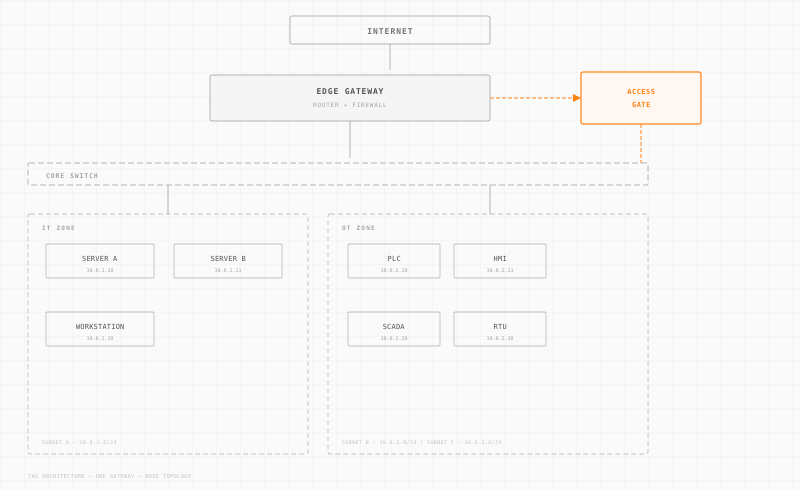
Access Gate treats wireless clients like any other untrusted device. Instead of dropping every radio onto a flat network, it enforces identity-based access as an agent-free overlay, so a scanner reaches the one system it needs and nothing else, and an engineering laptop reaches a machine only through a proxied, logged session. Asset discovery flags rogue or unknown wireless devices, and east-west monitoring forwards the traffic to your SIEM. See Manufacturing security for how this fits a plant network.