User Datagram Protocol (UDP) is a communication protocol used across the Internet for time-sensitive transmissions such as video playback or DNS lookups. Unlike TCP, UDP is a connectionless protocol that provides no error recovery, making it faster and more efficient for specific tasks where speed is more critical than reliability.
Understanding UDP in OT/IT Cybersecurity
In the context of Operational Technology (OT) and Information Technology (IT) cybersecurity, UDP plays a significant role in network communications, especially where low latency and reduced overhead are prioritized. UDP's design allows for the transmission of packets without establishing a prior connection, which means data can be sent swiftly without the delays associated with connection setup.
UDP Characteristics
- Connectionless: UDP does not require a handshake before data transmission, which reduces latency.
- Unreliable: It does not provide guarantees for message delivery, ordering, or data integrity, as it lacks mechanisms for error checking and correction.
- Efficient: With minimal protocol mechanism, UDP allows for fast data streaming, which is particularly useful in real-time applications.
- Broadcast and Multicast Support: UDP can efficiently handle broadcast and multicast transmissions, making it suitable for applications like streaming and gaming.
Relevance in Industrial, Manufacturing, & Critical Environments
In environments such as industrial and manufacturing facilities, where Industrial Control Systems (ICS) and Supervisory Control and Data Acquisition (SCADA) systems are prevalent, UDP is often used for its speed and efficiency. These systems frequently require real-time updates and control commands that can tolerate some packet loss but cannot afford delays.
For example, in a manufacturing plant, UDP might be used to send real-time sensor data to a central monitoring system. The faster the data can be transmitted, the more responsive the system can be in adjusting to changes, ensuring smooth operations.
Security Considerations
While UDP's speed and efficiency are beneficial, its lack of built-in security features can pose significant risks. Without error-checking and session management, UDP is vulnerable to issues such as packet spoofing and denial-of-service (DoS) attacks. In critical infrastructures, ensuring secure UDP communication often involves implementing additional security measures, such as firewalls and intrusion detection systems, and adhering to standards like NIST SP 800-171 and IEC 62443 for securing network communication.
Standards and Compliance
- NIST SP 800-171: This standard provides guidelines for protecting controlled unclassified information, including recommendations for secure network communications that can be applied to UDP traffic.
- CMMC: The Cybersecurity Maturity Model Certification outlines practices to safeguard federal contract information and Controlled Unclassified Information, relevant for environments using UDP.
- NIS2 Directive: Focused on improving cybersecurity across the EU, NIS2 includes provisions that can impact how UDP traffic should be managed to ensure network resilience.
- IEC 62443: This series of standards provides a framework for securing industrial automation and control systems, emphasizing secure communication protocols, including UDP.
In Practice
To leverage UDP effectively in industrial settings, it is crucial to balance the need for speed with security imperatives. This can involve:
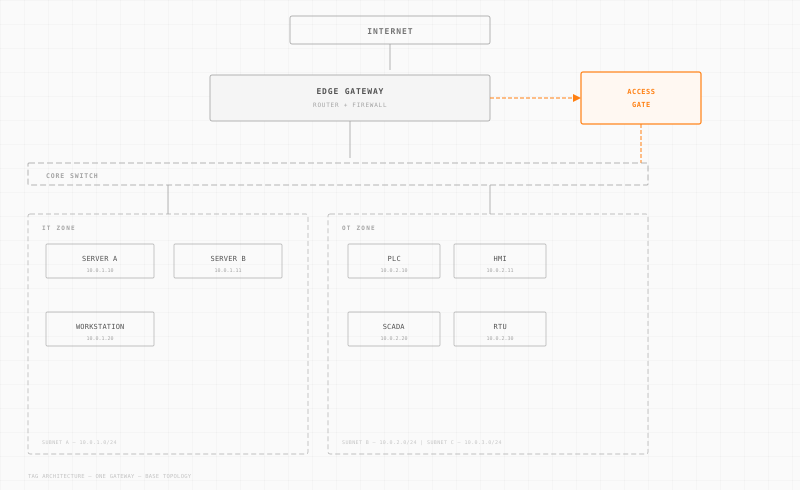
- Segmentation: Using network segmentation to isolate UDP traffic from critical operations.
- Monitoring: Implementing robust monitoring solutions to detect and respond to anomalous UDP traffic patterns.
- Encryption: Employing encryption where feasible to protect the integrity and confidentiality of UDP communications.