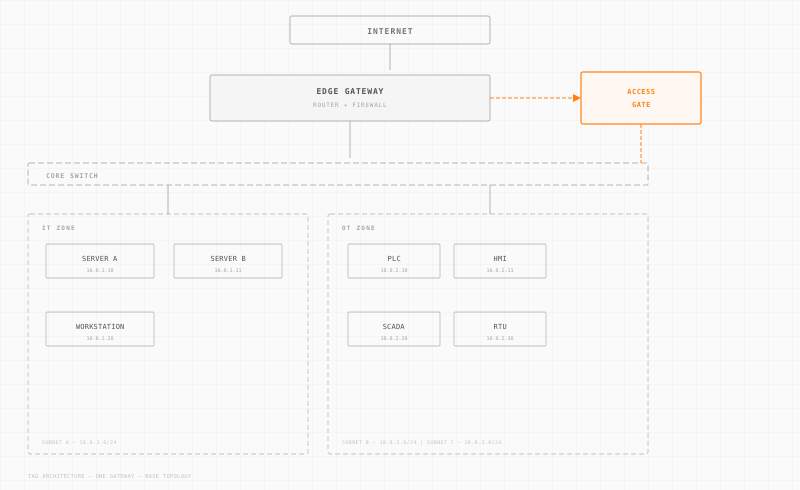
Remote privileged access management (RPAM) is the practice of securing, controlling, and recording the privileged sessions that remote users, whether employees or third-party vendors, open into critical systems. Instead of handing out a standing VPN and broad network access, RPAM grants access to a specific system, for a specific task, for a limited time, and records what happens. Analysts have named it as a distinct category because remote privileged access has become the access path attackers reach for most.
What is RPAM?
RPAM answers a narrow, high-stakes question: when someone connects from outside to do privileged work on a critical system, how do you make sure it is the right person, doing only the approved task, on only the approved system, with a record you can review afterward. It combines identity verification, just-in-time and least-privilege authorization, session brokering, and session recording into one controlled path. The point is to remove standing access and replace it with access that is granted on demand and revoked when the task is done.
How is RPAM different from PAM?
Traditional privileged access management grew up inside the enterprise, focused on vaulting credentials, rotating passwords, and managing privileged accounts. RPAM narrows the focus to the remote dimension: the session itself. It assumes the user is outside the perimeter, often on an unmanaged device, and sometimes an external contractor you do not control. So it emphasizes brokering the connection, binding it to a verified identity, scoping it to a single target, and recording it, rather than only managing the secret behind the account.
How is RPAM different from a VPN?
A VPN puts the remote user on the network. Once connected, and if the network is flat, they can reach far more than the one system they came to work on. RPAM adds control on top of that link: the connection ends at a broker, and the broker grants a path to exactly one system for exactly one task. Nothing else on the network is reachable. That difference is why flat VPN access into privileged systems is now treated as a liability rather than a control.
Why does RPAM matter for OT?
In operational technology, the most privileged and most exposed access is usually remote vendor maintenance. Integrators and OEMs connect in to service PLCs, drives, and SCADA systems that cannot authenticate a user or record a session on their own. That makes third-party remote access the classic OT breach path. RPAM applied to OT means placing a broker in front of those systems so every remote session, including a vendor's, is identity-bound, least-privilege, time-boxed, and recorded, without installing anything on the equipment.
What should an RPAM solution do?
The core capabilities are consistent across vendors:
- Verify identity against your identity provider, with multi-factor authentication, or act as the identity anchor when there is not one.
- Grant just-in-time, least-privilege access to a single target system for a single task, then revoke it.
- Broker the session so the user reaches only the one system the session allows.
- Record every session end to end, so an incident is a lookup rather than a forensic project.
- Work with legacy systems that cannot host an agent or authenticate on their own.
Trout's Access Gate delivers RPAM for industrial environments: it sits in front of OT assets and brokers identity-bound, least-privilege, recorded remote access, especially for third-party vendors, without changing the controllers. See secure OT remote and vendor access.