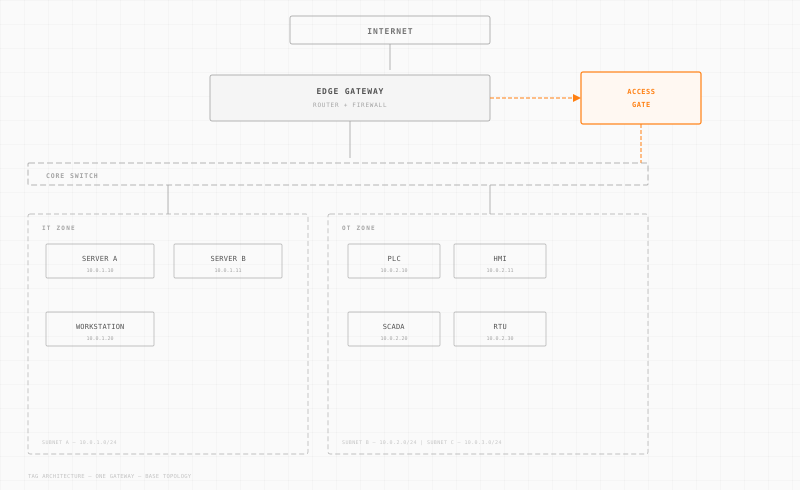
A machine network is the industrial communication layer that connects the machines on a plant floor: programmable logic controllers, human-machine interfaces, sensors, drives, and actuators. It is also called an industrial network or an OT network. Unlike an IT network built for throughput and data, a machine network is built for determinism and uptime, where a late packet can stall a line or trip a safety interlock.
What is a machine network?
It is the wiring and protocols that let field devices talk to controllers and to each other in real time. A PLC polls sensors, computes logic, and drives actuators on a fixed cycle measured in milliseconds. HMIs read that state so an operator can see and adjust the process. The traffic runs over industrial protocols like Modbus TCP, EtherNet/IP, PROFINET, and DNP3, often on the same physical Ethernet you would find in an office but with very different expectations for latency and jitter.
How is a machine network different from an IT network?
They optimize for opposite things. An IT network tolerates a dropped packet because TCP will resend it, and it patches on a monthly cadence. A machine network cannot tolerate that. A retransmission delay that nobody notices in email can violate a control loop's timing budget and halt production. Devices run for a decade or more without a reboot, many cannot take an agent, and a lot of them speak plaintext protocols with no authentication. That is why you cannot simply drop IT security tooling onto the plant floor and expect it to fit. See OT/IT convergence for where the two worlds meet.
Why does securing a machine network matter?
Because the consequences are physical. A compromised machine network is not a data breach, it is a stopped line, a ruined batch, or a defeated safety system. In a chemical plant, manipulated setpoints can drive a dangerous reaction. In a power station, they can trip generation. The Purdue Model exists to keep these networks layered and separated from enterprise IT for exactly this reason, and standards like IEC 62443 and NIST SP 800-82 codify how to do it. For defense manufacturers, the same network segmentation that protects the process also protects controlled unclassified information under CMMC.
How do you secure a machine network without touching the machines?
The honest constraint is that most field devices cannot defend themselves, so the defense has to live in the network. That means network segmentation to contain lateral movement, zero-trust access so no host is trusted by default, and continuous monitoring of east-west traffic to catch anomalies early.
How Access Gate helps
Access Gate is an agent-free overlay, so it segments a machine network without re-addressing devices or installing anything on a PLC. It puts an identity-enforced boundary around each asset or cell, proxies remote and vendor sessions through a logged access point, discovers what is actually on the network, and forwards east-west traffic to your SIEM. The machines keep speaking their native protocols while every session reaching them is authenticated and recorded. See Manufacturing security for the full picture.