
Trout Access Gate includes a dedicated Monitoring capability that gives operators clear, real-world visibility into how assets communicate inside their network. Trout can build this picture from three complementary inputs, used on their own or combined, and all of them populate the asset inventory without touching production.
Ways to feed the inventory
- NetFlow: the Access Gate's monitoring port ingests NetFlow records exported by an existing router, firewall, or L3 device. It does not sit inline and requires no rewiring; it simply receives metadata about flows your network already observes.
- Port SPAN (mirroring): point a mirrored (SPAN) port from a managed switch at the monitoring interface to feed raw traffic directly. This is useful where NetFlow is not available but the switch can mirror a segment.
- pcap injection: upload a packet capture taken on site and Trout replays it to pre-populate the inventory. This is ideal ahead of an installation: capture a pcap from the existing environment, share it with Trout or your integration partner, and the Access Gate arrives already knowing your network.
Whichever input you use, Trout reconstructs service usage, port activity, communication patterns, and asset behavior over time, forming the foundation for building and maintaining secure enclaves.
What the Monitoring Port Is
You can configure network interfaces of the Access Gate as a monitoring port. When enabled, this port listens for NetFlow records exported by your existing router or firewall.
The monitoring port is therefore:
- A passive, out-of-band interface
- A single Ethernet connection from Trout to the existing router
- A way to leverage the router’s vantage point without modifying the network
- A tool to kick start an inventory asset or build the initial enclaves with precision
This makes it possible to deploy Trout quickly on any site, even those with legacy assets, strict uptime constraints, or complex environments where modifying networks is impractical.
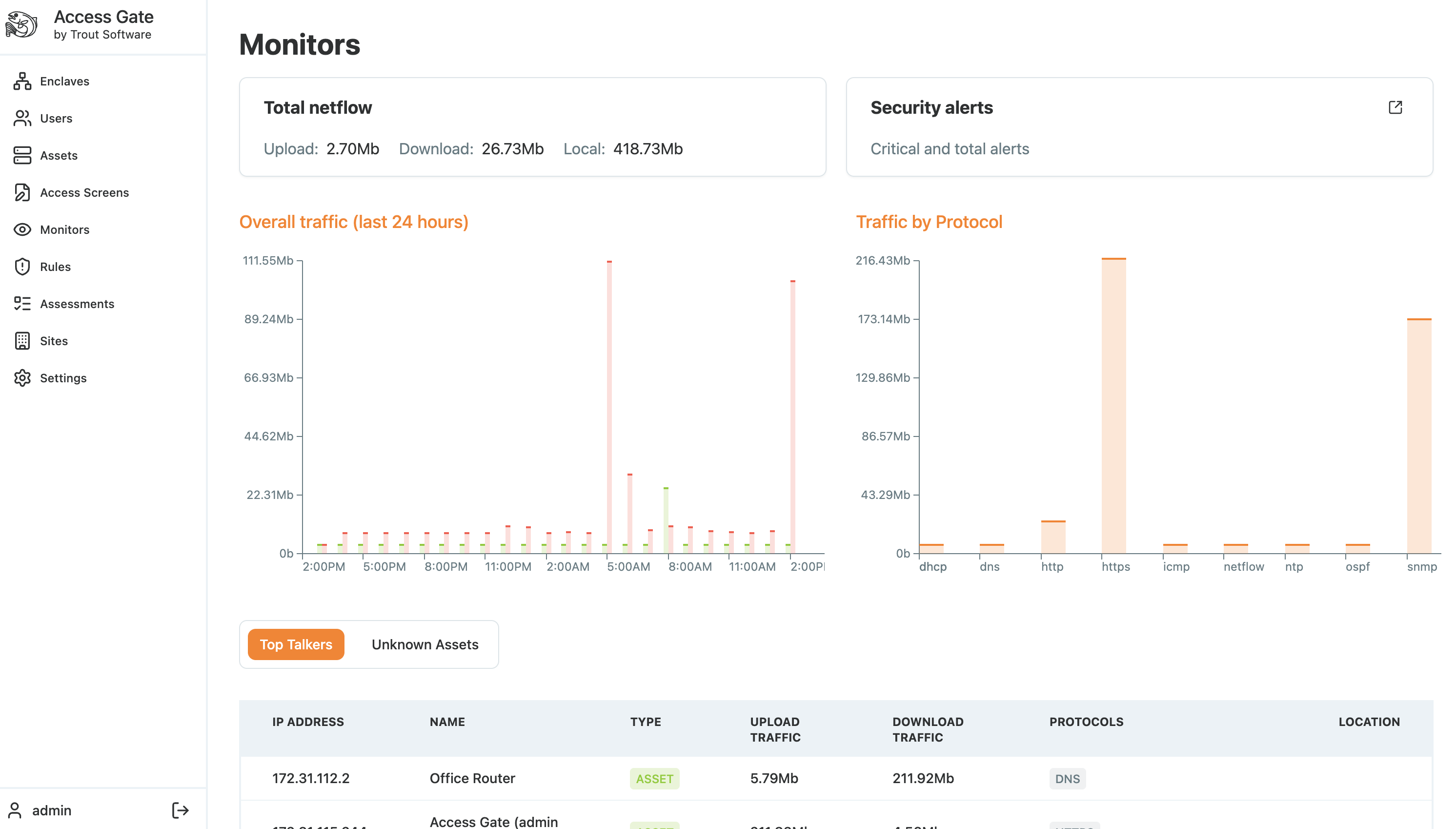
Why NetFlow Matters
NetFlow provides concise information about the communication happening inside a network: which IPs are talking, which ports and services are used, how often, and with how much volume.
When NetFlow reaches the Access Gate, Trout converts these raw flow records into:
- A per-asset view of port activity and protocols
- Timelines showing which services were used and when
- Correlation with the asset inventory
- Early signs of misconfigurations or changes
- Evidence needed to design Zero-Trust enclaves
In other words, NetFlow is the foundation for Trout’s monitoring intelligence.
From Network Visibility to Security Design
The insights derived from the monitoring port are used directly to design, deploy, and refine Trout’s Zero-Trust architecture inside a site.
Building an Asset Inventory
NetFlow reveals which devices exist on the network, how they communicate, what roles they perform, and which ports they rely on.
This makes it possible to:
- Automatically discover assets
- Validate manually imported inventory
- Identify miscategorized or unknown devices
These signals help teams understand the true operational requirements of each asset.
With a one click option, users are able to incrementally build their asset inventory and maintain it through time.
Creating Secure Enclaves (Micro-DMZs)
Once a user understands which devices communicate with which services and peers, it becomes straightforward to design proper enclaves:
- Group assets that need to communicate
- Harden communication to only the required ports and protocols
- Define RBAC access requirements
Maintaining the Environment Over Time
As assets change ports, update firmware, or alter behavior, Trout flags:
- New ports & protocols
- Newly observed communication partners
- Traffic volume anomalies
- Changes inconsistent with the baseline
This operational intelligence ensures Zero-Trust configurations remain accurate and compliant.
How to Configure the Monitoring Port on the Access Gate
Refer to the dedicated how-to on this documentation.
A Non-Intrusive Way to Gain OT Visibility
Because the monitoring port uses NetFlow from equipment already installed on the network, Trout delivers deep visibility without intrusive controls or architectural changes. Sensitive assets remain untouched. Production stays online. The router exports metadata, and Trout transforms it into operational intelligence.
This makes it possible to deploy Zero-Trust and micro-DMZ architectures in environments where downtime, recabling, and intrusive inspection are simply not options.